
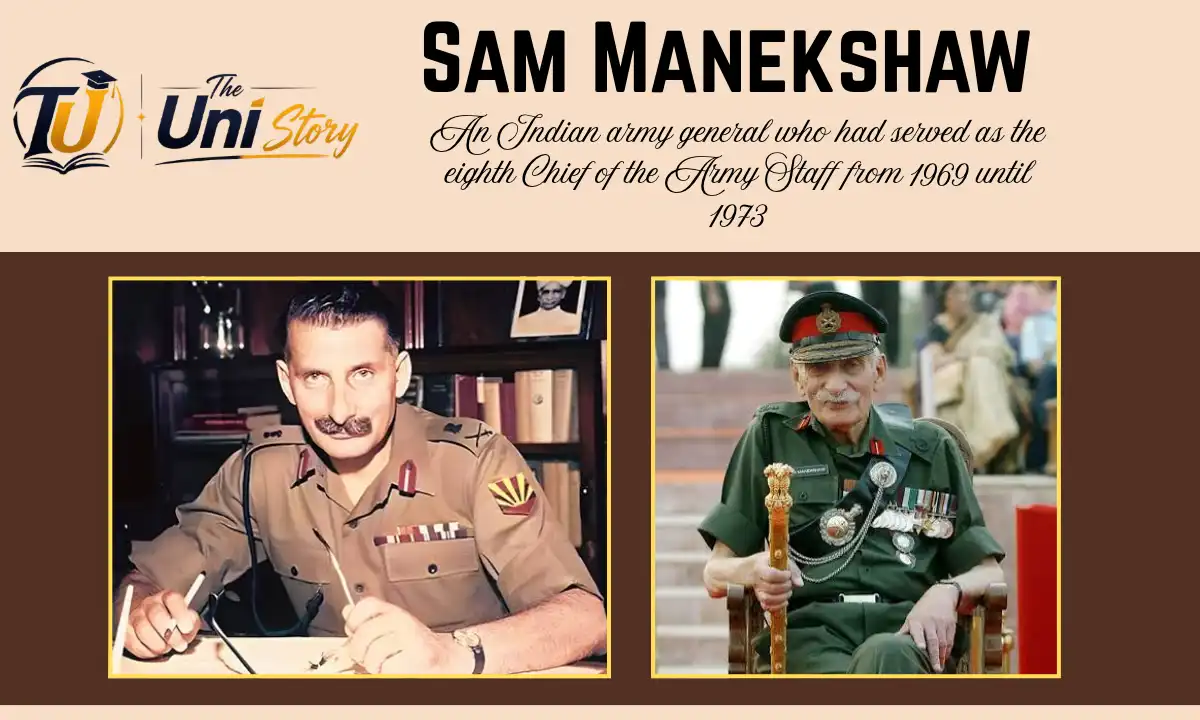
Sam Manekshaw, commonly known as Sam Bahadur, was one of the most remarkable military commanders in the history of India. He was the first Indian Army officer to be appointed as a Field Marshal with a five-star ranking and was instrumental in India’s win in the 1971 Indo-Pakistani war that led to the formation of Bangladesh.
He was born on 3rd April 1914 at Amritsar, Punjab and he had served in the British Indian Army and Indian Army for more than four decades. The period during which he worked comprised of the World War II era and many other significant battles of India.
Besides being an excellent military commander, he was revered for his bravery, strategy, integrity and sense of humor.
Sam Manekshaw Biography – Quick Information
| Details | Information |
|---|---|
| Full Name | Sam Hormusji Framji Jamshedji Manekshaw |
| Popular Name | Sam Manekshaw |
| Nickname | Sam Bahadur |
| Date of Birth | 3 April 1914 |
| Birthplace | Amritsar, Punjab, British India |
| Nationality | Indian |
| Religion | Parsi (Zoroastrian) |
| Zodiac Sign | Aries |
| Profession | Military Officer |
| Father | Hormizd Manekshaw |
| Mother | Hilla Manekshaw |
| Wife | Silloo Bode |
| Children | Sherry Batliwala and Maja Daruwala |
| Education | Sherwood College, Hindu Sabha College, Indian Military Academy |
| Military Service | 1934–1973 |
| Highest Rank | Field Marshal |
| Famous For | Leadership in the 1971 Indo-Pakistani War |
| Awards | Military Cross, Padma Bhushan, Padma Vibhushan |
| Date of Death | 27 June 2008 |
| Age at Death | 94 Years |
| Death Place | Wellington, Tamil Nadu |
Who Was Sam Manekshaw?
Sam Manekshaw was an Indian army general who had served as the eighth Chief of the Army Staff from 1969 until 1973. He earned himself fame because of his commanding during the 1971 Indo-Pakistani War, which ended in a complete victory for India.
Sam Manekshaw was the first Field Marshal, the highest military rank of the Indian Army, to have come out from the Indian Army. Sam Bahadur is a nickname meaning Sam the Brave.
His straightforward nature, professionalism and decision-making were some of the traits for which he became popular. His commanding during the 1971 war still stands out as one of the proudest moments in the defence of India.
Sam Manekshaw Age, Date of Birth and Birthplace
Sam Manekshaw was born on 3 April 1914 in Amritsar, Punjab, under the British reign of India. He grew up in a Parsi family and then shifted to Nainital for education.
He died after living for 94 years at Wellington, Tamil Nadu on 27 June 2008.
Sam Manekshaw Early Life and Family Background
Sam Manekshaw belonged to a Parsi community family. His father, Hormizd Manekshaw was a doctor who had come from Gujarat to Punjab and had set up his own medical practice in Amritsar. His mother’s name was Hilla Manekshaw.
He was the fifth child in a family of six siblings. Both his parents were keen on education, discipline and professional success.
Sam initially wished to pursue his career in medicine and had planned to join the study of medicine in London. But his father refused to send him out of the country as he felt that he was too young to be left alone.
This led Sam to explore other avenues, and he finally applied to the Indian Military Academy. He began his life’s quest of becoming one of the best military commanders in India.
Sam Manekshaw Educational Qualifications
Sam Manekshaw completed his early education in Punjab. Then he joined Sherwood College situated in Nainital in Uttarakhand state of India. He spent about eight years at this institution and passed his Senior School Examination.
Post his schooling, he joined Hindu Sabha College in Amritsar. In 1932, he got through the entrance examination of the Indian Military Academy of Dehradun.
He ranked sixth in open competition and joined The Pioneers Batch of the academy.
| Education | Institution |
|---|---|
| School | Sherwood College, Nainital |
| College | Hindu Sabha College, Amritsar |
| Military Training | Indian Military Academy, Dehradun |
| IMA Admission | 1932 |
| Commissioned | February 1934 |
Sam Manekshaw Height and Physical Appearance
Sam Manekshaw’s reported height was approximately 173 cm (5 feet 9 inches). He was known for his confident personality, distinctive moustache and commanding military presence.
| Physical Details | Information |
|---|---|
| Height | 173 cm |
| Height in Feet | 5 feet 9 inches |
| Height in Meters | 1.73 m |
| Weight (Reported) | Approximately 65 kg |
| Eye Colour | Dark Brown |
| Hair Colour | Black |
Sam Manekshaw Military Career Journey
The military career of Sam Manekshaw started after he joined the Indian Military Academy in 1932. He was commissioned in February 1934 and first served with the 2nd Battalion of the Royal Scots before moving to the 4th Battalion of the 12th Frontier Force Regiment.
Sam Manekshaw had a military career that spanned over four decades. He served during the Second World War and went on to occupy various key positions within the Indian Army.
After India’s independence of India, he got involved in the planning and senior command duties of the military. He rose to become the Chief of the Army Staff in 1969.
Military Career TimelineAchievement
| Year | Achievement |
|---|---|
| 1932 | Joined the Indian Military Academy |
| 1934 | Received military commission |
| 1942 | Participated in World War II |
| 1942 | Received the Military Cross |
| 1947 | Worked in military planning after Partition |
| 1952 | Became Commander of 167 Infantry Brigade |
| 1955 | Became Commandant of the Infantry School |
| 1959 | Became Commandant of Defence Services Staff College |
| 1962 | Appointed Commander of IV Corps after the main conflict |
| 1969 | Became Chief of the Army Staff |
| 1971 | Led the Indian Army during the Indo-Pakistani War |
| 1973 | Received the rank of Field Marshal |
Sam Manekshaw During World War II
World War II marked another important phase of Sam Manekshaw’s military career, as he fought in the Burma Campaign in the British Indian Army against the Japanese.
In February 1942, while engaging in battles near Pagoda Hill along the banks of the Sittang River, he initiated a counter attack against the enemy. While on this mission, he got wounded by Japanese machine gun fire. Major General David Cowan, who saw Manekshaw’s valor, fastened his own Military Cross ribbon on Manekshaw, thinking that he may not live anymore.
The Military Cross was later awarded to Manekshaw for his gallantry. His orderly, Sepoy Sher Singh, also played a vital role in saving his life by providing the necessary help to him.
After recovery, Manekshaw continued to serve in the army and joined the Staff College at Quetta.
Sam Manekshaw Post India’s Independence
After the year 1947, Manekshaw continued to serve in the Indian Army. The original regiment of Manekshaw now came under the Pakistan Army. He was shifted to Indian Army’s 8th Gorkha Rifles.
He worked in the Military Operations Directorate and also helped in planning the military strategies related to the Jammu and Kashmir operations and Hyderabad crisis.
Manekshaw later held several high posts, such as Commander of 167 Infantry Brigade, Commandant of the Infantry School and Commandant of the Defence Services Staff College.
Sam Manekshaw and the 1962 India-China War
India-China War of 1962 was a tough time for the Indian military forces. After the war, Sam Manekshaw became the Commander of IV Corps in the eastern sector.
He made efforts to organize military forces and improve discipline and morale among soldiers.
Under his leadership, there was a considerable improvement in the command system and many of the issues arising out of operations were addressed.
Sam Manekshaw and 1971 Indo-Pakistani War
The 1971 Indo-Pakistani War is perhaps the biggest success of Sam Manekshaw’s military career.
The war originated in the political turmoil of East Pakistan, wherein the violence and military repression led to the migration of millions of refugees into India.
In his capacity as the Chief of the Army Staff, Sam Manekshaw played an important role in ensuring the military preparedness of the Indian forces.
Sam Manekshaw’s Military Strategy in the 1971 War
In April 1971, Prime Minister Indira Gandhi consulted Sam Manekshaw regarding the military intervention in the political turmoil in East Pakistan.
He made it clear that the Indian Army was not ready for the operation. The coming monsoon season, rugged terrain in East Pakistan, military logistics, and the situation on the northern frontiers were some of the factors to be taken into account.
His advice was accepted, and the army prepared itself for the forthcoming operation.
India’s Victory in the 1971 War
Full-scale war started on 3 December 1971 after the Pakistani air strikes on Indian air bases.
Indian troops made operations both on the eastern and western fronts. In the eastern theater, the Indian Army had collaborated with the Mukti Bahini that consisted of Bangladeshi liberation forces.
Indian troops moved toward Dhaka defeating the defense forces of Pakistan and occupying key places.
Pakistani troops surrendered at Dhaka on 16 December 1971. The Instrument of Surrender was signed by Lt. General A. A. K. Niazi and accepted by Lt. General Jagjit Singh Aurora.
The war brought to the creation of Bangladesh and marked the name of Sam Manekshaw as one of India’s greatest generals.
Sam Manekshaw Promotion to Field Marshal
Sam Manekshaw was awarded the rank of Field Marshal, which is represented by five stars, on 15 January 1973 due to his distinguished service.
Manekshaw became the first Field Marshal among the officers of Indian Army. The rank of the second Field Marshal among Indian Army was awarded to General K. M. Cariappa in 1986.
| Detail | Information |
|---|---|
| Highest Rank | Field Marshal |
| Promotion Date | 15 January 1973 |
| Chief of Army Staff | 1969–1973 |
| First Indian Field Marshal | Sam Manekshaw |
| Second Indian Field Marshal | K. M. Cariappa |
Sam Manekshaw Awards and Achievements
Throughout his career, Sam Manekshaw received several military decorations and civilian honours for his courage and contribution to India.
| Award | Year |
|---|---|
| Military Cross | 1942 |
| Padma Bhushan | 1968 |
| Padma Vibhushan | 1972 |
| Field Marshal Rank | 1973 |
His Military Cross recognised his bravery during World War II, while the Padma awards recognised his distinguished service to the nation.
Sam Manekshaw Wife and Children
Sam Manekshaw married Silloo Bode on 22 April 1939 in Bombay, now known as Mumbai. They first met in Lahore in 1937.
Silloo was always by the side of her husband in his tough military career. Regardless of the numerous postings and professional commitments, they had a family bond.
They had two daughters: Sherry and Maja. Silloo died in 2001, seven years before the death of Sam Manekshaw.
| Family Member | Name |
|---|---|
| Wife | Silloo Bode |
| Elder Daughter | Sherry Batliwala |
| Younger Daughter | Maja Daruwala |
Sam Manekshaw Net Worth and Salary
The net worth of Sam Manekshaw has not been verified yet. He mainly made his money through his military career, after which he joined private corporations as a member of their board of directors.
In 2007, he was paid around ₹1.3 crore of outstanding payment in connection with his Field Marshal designation.
| Financial Detail | Information |
|---|---|
| Net Worth | Not publicly verified |
| Main Income | Military Service |
| Other Work | Corporate Board Appointments |
| Field Marshal Arrears | Approximately ₹1.3 crore |
| Year | 2007 |
Sam Manekshaw Death and Legacy
Sam Manekshaw died on 27th June 2008 at the Military Hospital of Wellington, Tamil Nadu, at the age of 94 due to complications arising from pneumonia.
Sam Manekshaw was buried at the Parsi Zoroastrian Cemetery of Ooty, Tamil Nadu, beside his wife.
His legacy in the military history of India cannot be overlooked. The strategies he used in the 1971 war, his dedication to soldiers,, and professional integrity keep motivating military people.
Manekshaw’s name is immortalized by the Manekshaw Centre located in New Delhi, which has some connections with defense.
Sam Bahadur Movie
The movie ‘Sam Bahadur’ is a 2023 Hindi biopic based on the story of Field Marshal Sam Manekshaw.
Field Marshal Sam Manekshaw was acted by Vicky Kaushal, while the director of the movie was Meghna Gulzar. It was released on 1st December 2023.
| Movie Details | Information |
|---|---|
| Film Name | Sam Bahadur |
| Release Date | 1 December 2023 |
| Lead Actor | Vicky Kaushal |
| Director | Meghna Gulzar |
| Genre | Biographical War Drama |
| Language | Hindi |
The film introduced his military achievements and personal journey to a wider audience.
Lesser-Known Facts About Sam Manekshaw
- He was called Sam Hormusji Framji Jamshedji Manekshaw in full.
- Sam was born on 3rd April 1914 in Amritsar.
- At first, Sam wanted to be a doctor.
- He was part of the first batch of the Indian Military Academy.
- He ranked sixth in the IMA selection test.
- He suffered severe injuries during World War II.
- In 1942, Sam won the Military Cross.
- He is commonly known as Sam Bahadur.
- He was India’s first Field Marshal.
- Sam loved photography, fishing and horse racing.
- He had two daughters.
- The life story of Sam has been depicted in a movie named ‘Sam Bahadur’ in 2023.
Conclusion
Sam Manekshaw has been among the most remarkable military leaders of Indian history. The life of Sam, from Indian Military Academy to World War II and from there to 1971 Indo-Pakistani War reflects his courage, discipline and professionalism.
Being India’s first Field Marshal, Sam has left behind a wonderful military legacy. The military strategies, truthfulness and concern for the soldiers of Sam are an inspiration for coming generations.
Frequently Asked Questions
Who was Sam Manekshaw?
Sam Manekshaw was an Indian military commander and the first Indian Army officer to receive the rank of Field Marshal.
When was Sam Manekshaw born?
He was born on 3 April 1914 in Amritsar, Punjab.
What was Sam Manekshaw’s age at death?
He was 94 years old when he passed away on 27 June 2008.
Who was Sam Manekshaw’s wife?
His wife’s name was Silloo Bode, whom he married in 1939.
How many children did Sam Manekshaw have?
He had two daughters, Sherry Batliwala and Maja Daruwala.
Why was Sam Manekshaw called Sam Bahadur?
He was popularly known as Sam Bahadur, meaning Sam the Brave.
When did Sam Manekshaw become Field Marshal?
He received the rank of Field Marshal on 15 January 1973.
What was Sam Manekshaw famous for?
He was famous for his leadership during the 1971 Indo-Pakistani War.
Also read about: Saba Azad Age | Rowhi Rai Boyfriend | Maithili Thakur Height | Dimple Yadav Age | Amit Shah Son Name